The Real Story Behind Claude Code: Why “1 Hour vs. 1 Year” Misses the Point
What 10 sources reveal about the birth of programmable work
A Google Principal Engineer admitted that Claude Code replicated in one hour what her team spent a year building.
The headline went viral. 5.4 million views. Engineers everywhere shared it with a mix of awe and existential dread.
But everyone focused on the wrong insight.
The real story isn’t about speed. It isn’t about AI replacing developers. And it certainly isn’t about code.
After analyzing 10 sources—from the creator’s own workflow to power users who’ve spent 10 months building production systems—I discovered something far more significant: we are witnessing the birth of a new computing paradigm where work itself becomes programmable.
Let me show you what I mean.
The Consensus Bottleneck Nobody Talks About
Here’s what actually happened with that Google engineer, Jaana Dogan.
Her team didn’t spend a year writing code. They spent a year debating approaches. Multiple solutions were explored. No consensus was reached. The technical work was actually the easy part.
Then Dogan sat down with Claude Code, wrote a three-paragraph prompt based on simplified versions of ideas they’d already discussed, and got a working prototype in an hour.
“Quality and efficiency gains in this domain are beyond what anyone could have imagined so far.”
The AI didn’t write code faster than humans. It collapsed the deliberation bottleneck.
Think about your own projects. How much time is spent actually coding versus debating architecture? Discussing trade-offs? Building consensus across stakeholders?
Claude Code’s greatest value may not be writing code. It may be eliminating organizational friction.
The Creator Runs 15 Claudes in Parallel
Boris Cherny created Claude Code as a side project in September 2024. Today, his workflow looks nothing like what you’d expect.
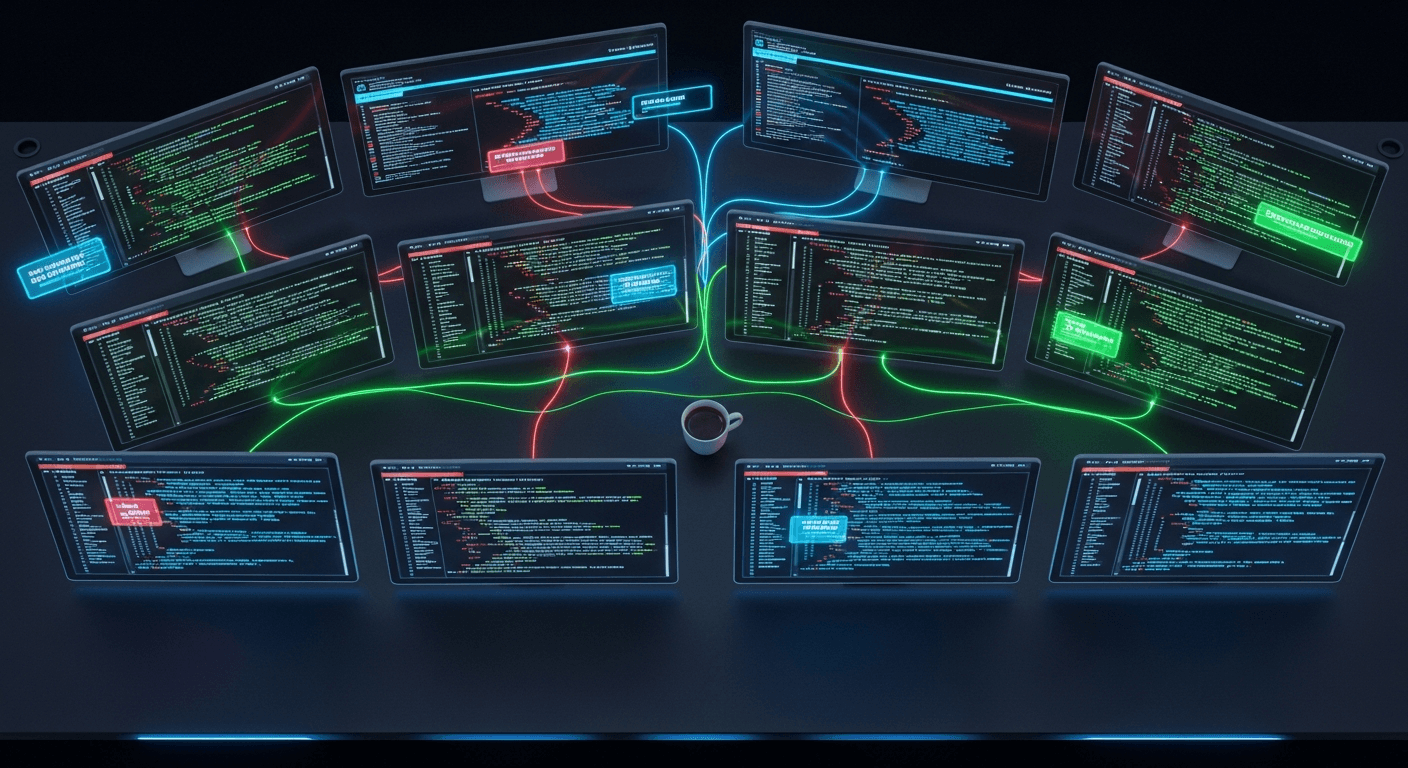
He runs 5-15 instances simultaneously.
Five terminal sessions, numbered 1-5, with system notifications alerting him when one needs input. Another 5-10 sessions running in the browser on claude.ai. He uses a --teleport command to transfer sessions between environments.
Each local session gets its own git checkout—not branches, not worktrees, full separate clones. About 10-20% of sessions are abandoned when unexpected scenarios arise.
This isn’t “using an AI assistant.” This is orchestrating a parallel workforce.
“My setup might be surprisingly vanilla! Claude Code works great out of the box.”
The irony? The creator doesn’t over-customize. He treats Claude Code as a reliable worker that can be multiplied, not a fragile tool that needs extensive configuration.
Why Verification Matters More Than Model Intelligence
Here’s Cherny’s most important insight:
“Give Claude a way to verify its work. If Claude has that feedback loop, it will 2-3x the quality of the final result.”
His implementation: Claude tests every change using the Chrome extension. It opens a browser, navigates to the site, tests the UI, and iterates until the code works and the UX feels good.
This overturns a common assumption—that AI output quality is determined by model capability. It’s not. Quality is a function of feedback architecture.
A well-designed Claude Code setup with current models may outperform future models without that architecture. This suggests a counterintuitive investment strategy: spend time building verification loops rather than waiting for GPT-5.
The 2-3x quality improvement isn’t theoretical. It’s what the creator experiences daily.
“The Biggest Thing Since ChatGPT”
When security researcher Daniel Miessler described Claude Code’s skills system as “the biggest thing since ChatGPT,” I was skeptical.
After this research, I think he might be right.
Skills turn work into directories. Each skill contains:
- A SKILL.md file (routing and documentation)
- Workflows (step-by-step procedures)
- Tools (executable utilities)
Miessler maintains 65+ skills covering security analysis, content creation, and research automation. When he gives Claude Code a request, it automatically routes to the appropriate skill.
Here’s why this matters: when work becomes a directory, it gains the properties of software.
Version control. Track changes to your workflows. Roll back mistakes.
Sharing. Transfer expertise between people instantly.
Composition. Combine skills into complex workflows.
Compounding. Each skill makes the next skill easier to create.
“It’s a way of turning work into a directory.”
Each skill is a solved problem that never needs solving again. Unlike traditional software, skills are natural-language-accessible, lowering the barrier to reuse. Unlike documentation, skills are executable.
It’s software compound interest for knowledge work.
The Self-Improvement Cycle Is Already Running
Here’s the stat that should alarm and excite everyone:
“100% of my contributions to Claude Code were written by Claude Code.”
That’s 40,000 lines of new code, written by the tool itself.
This isn’t a hypothetical future capability. This is what’s happening now. Claude Code is already in a positive feedback loop where it improves its own abilities.
The implication: capability growth may not be linear. Each improvement makes the next improvement easier. The tool that builds tools that build tools creates exponential rather than incremental progress.
Dev Tools Aren’t Just for Developers Anymore
George (known as @nurijanian on Twitter) built a functional ADHD Focus App over a weekend.
He has zero coding background.
His workflow: Watch Andrew Huberman’s YouTube video on focus. Run it through NotebookLM to extract the science. Give Claude Code the structured insights. Build the app.
The app is live. It works.
“Dev tools are not just for developers anymore.”
This represents a fundamental shift in who can create software. The barrier has moved from “can you code?” to “can you clearly describe what you want?”
The Two-Tier Economy (And Why the Window Is Closing)
There’s a catch to all this: you need to be comfortable with a terminal.
Claude Code lives in the command line. If typing cd ~/projects intimidates you, the current version isn’t accessible.
This creates what one analyst called a “two-tier economy”—those who master Claude Code and those who don’t. The divide is real, and it’s growing.
But here’s the thing: the window is closing.
Claude for Excel and similar simplified interfaces are emerging. Within 12-18 months, the terminal literacy barrier will fall.
Those who develop Claude Code proficiency now gain compounding advantages. Those who wait for easier interfaces will catch up eventually, but they’ll start from behind—without the skills, workflows, and institutional knowledge that early adopters have accumulated.
The arbitrage opportunity is time-limited.
What This Means For You
If you’re a developer:
Invest in terminal literacy and Claude Code proficiency now. The compound returns are enormous.
Start building a personal skill library. Begin with your highest-frequency workflows—the things you do every day. Encode them as skills, version-control them, iterate.
Shift your mindset from “writing code” to “architecting verification loops and orchestrating agents.”
If you’re not technical:
The barrier is lower than you think. George proved it. A weekend and clear descriptions of what you want can produce working software.
Simplified interfaces are coming, but early adoption yields 12-18 months of advantage. Learn basic terminal commands now.
If you lead a team:
Establish CLAUDE.md practices immediately. Document mistakes and best practices in a file that Claude reads. Build institutional memory that compounds with every interaction.
Identify parallelizable workstreams. Invest in verification infrastructure before scaling to multiple instances.
Teams that delay will face capability gaps that compound over time.
The Bottom Line
The “1 hour vs. 1 year” headline captured attention but missed the point.
The real story is the emergence of a new paradigm where work itself becomes programmable. Skills make domain expertise modular. Verification loops make quality architectural. Parallel execution makes the human an orchestrator. And the self-improvement cycle suggests this is just the beginning.
The question has shifted.
It’s no longer “can you code?”
It’s “can you clearly describe what you want?”
Those who recognize this shift—and invest in terminal literacy, skill libraries, and verification architecture now—will compound advantages for years.
The window is open. It won’t stay open forever.
This analysis is based on 10 sources including workflows from Claude Code’s creator, power user configurations, and industry analysis. Full source list and detailed analysis available in the companion research document.